Hello Reader
Right now, the most electrifying energy story on the planet runs on Iranian crude and a ticking 60-day clock.
The future of oil now depend less on what lies beneath the ground than on what is signed above the table.
And this 60-day opening will test whether Washington's word is worth anything at the trading desk!
The issuance of a 60-day US Treasury authorization permitting Iranian crude oil and petrochemical exports marks, if fully implemented, one of the most consequential temporary shifts in sanctions policy in recent years. While framed as a technical or interim licensing arrangement tied to ongoing negotiations, its practical implications reach far beyond diplomacy. It touches Iran’s struggling economy, the fragile balance of global oil supply, and the already sensitive psychology of energy markets.
At first glance, the measure appears modest in duration, just two months. Yet in commodities markets, even short windows of regulatory easing can trigger outsized behavioral responses. Traders, refiners, and shipping firms tend to price not only current flows but also anticipated continuity. This makes the real question less about the 60-day horizon itself, and more about whether it signals a structural thaw or merely a tactical pause.
For Iran, the potential short-term upside is clear. Oil remains the backbone of its fiscal and foreign currency system. Years of sanctions have forced Tehran into heavily discounted sales through opaque supply chains, often relying on intermediaries and barter-like arrangements that erode net revenue. If the licensing framework genuinely allows broader access to insurance, banking channels, and shipping services, Iran’s export margins could improve significantly even without a dramatic increase in production volumes.
The most immediate benefit would likely be liquidity. Easier settlement mechanisms, especially anything resembling partial access to dollar-based transactions, would reduce transaction costs and delays. That, in turn, could stabilize the rial, ease import pressures, and give Tehran more fiscal room to manage domestic subsidies and public sector obligations.
However, even under optimistic assumptions, the gains would be incremental rather than transformative. Iran’s oil infrastructure has endured years of underinvestment, and production capacity cannot be rapidly expanded within a 60-day window. The real economic impact would therefore come from efficiency improvements and price realization, not a sudden surge in output.
From a global perspective, the re-entry of Iranian barrels, even partially, adds another variable to an already finely balanced supply-demand equation. The oil market in recent years has been characterized by coordinated production management among major exporters and intermittent disruptions linked to geopolitical tensions.
If Iranian exports increase meaningfully, even by a few hundred thousand barrels per day, the psychological effect could outweigh the physical supply change. Markets are highly sensitive to “headline barrels,” especially when they originate from a previously constrained producer.
The most likely short-term reaction would be a mild softening in Brent and WTI benchmarks, assuming other producers do not offset the increase with production cuts. However, any downward pressure is unlikely to be dramatic unless Iranian exports return to pre-sanctions scale, which remains improbable in such a limited timeframe.
A more important effect could be on refining flows in Asia and parts of Europe, where buyers often seek discounted crude grades. Iranian oil, if legally tradable under relaxed conditions, could re-enter those channels, displacing some alternative suppliers and reshaping regional trade margins.
The most significant opportunity lies not in the volume of oil, but in the political signaling embedded in energy access. Temporary easing creates a controlled environment for testing compliance, monitoring mechanisms, and financial transparency systems without committing either side to irreversible concessions.
For Iran, demonstrating reliability as a supplier could strengthen its negotiating position in broader diplomatic talks. For the United States and its partners, structured licensing provides leverage, an incentive-based framework that can be tightened or expanded depending on compliance.
In energy diplomacy, such calibrated openings often serve as pressure valves. They reduce immediate tensions while preserving bargaining power.
Yet the risks are equally pronounced. The most immediate is uncertainty. A 60-day window does not encourage long-term investment in logistics or production capacity. Shipping insurers, buyers, and banks may remain cautious, limiting the full effectiveness of the authorization.
There is also the question of enforcement ambiguity. Partial easing of sanctions regimes often creates gray zones, where compliance interpretation varies across jurisdictions. This can lead to uneven participation, with some firms engaging cautiously while others remain entirely on the sidelines.
Politically, the biggest risk is reversal. If negotiations stall, markets could quickly reprice Iranian supply back out of the system, creating volatility in both directions. That kind of policy oscillation tends to increase risk premiums in oil pricing, even if average supply levels remain stable.
Finally, domestic Iranian politics cannot be ignored. Any perception that concessions are temporary or reversible may fuel internal debate over the sustainability of diplomatic engagement, particularly if economic gains are perceived as limited or unevenly distributed.
What appears on paper as a narrow 60-day licensing arrangement could, in practice, act as a stress test for a wider geopolitical realignment. Its economic impact on Iran will likely be real but constrained, offering relief rather than recovery. For global oil markets, it introduces a modest supply variable but a significant psychological one.
In the end, the true significance of this development lies not in barrels produced or dollars earned over two months, but in whether it marks the beginning of a predictable framework, or another short-lived experiment in energy-driven diplomacy.
International Day of Women In Diplomacy
As the world marked the International Day of Women in Diplomacy on 24 June, The Diplomatic Insight pays tribute to every woman diplomat who has negotiated peace, represented her country with dignity, opened doors for the next generation, and shown that leadership in diplomacy is defined not by power alone, but by vision, empathy, courage, and responsibility.
On this special day, we have curated an open letter for women diplomats around the world. We invite you to read it.
A Heartfelt Letter to Women in Diplomacy
|
Conversation With a Diplomat
Exclusive Interview with Faisal Niaz Tirmizi
Ambassador of Pakistan to Russia
In this episode of Conversation With a Diplomat, H.E. Faisal Niaz Tirmizi, shares his remarkable personal journey, professional background, and the experiences that shaped his diplomatic career.

|
Why does UK seem unable to keep a Prime Minister in office long enough to govern effectively?
READ "UK’s Rotating Door of Prime Ministers: Is the Parliamentary System Under Strain?" HERE
By Farkhund Yousafzai
|
|
|
1919: America arrived at Versailles to help create a new world order.
107 years later, it struggles to save itself.
READ "Geopolitical Karma at Versailles: How Macron Delivered America’s Humiliation with Philosophical Precision" HERE
By Muhammad Mahad Samija
|
|
|
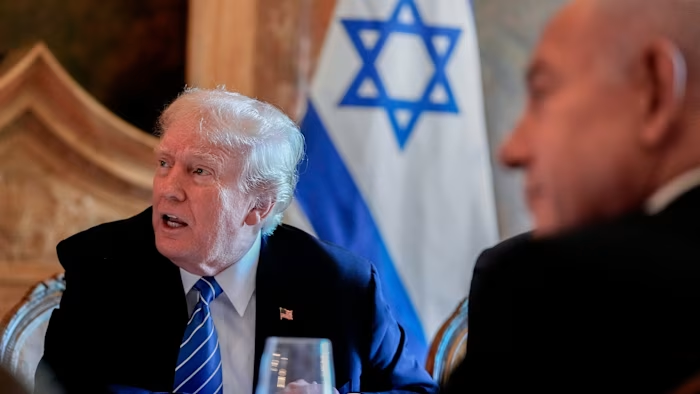
Is the US-Israel relationship coming to an end?
The answer is not yet. But the nature of the realtionship is changing.
READ "When Trump and Netanyahu Are On Different Paths" HERE
By Abdullah Akbar Rafsanjani
|
|
|
Get featured in our newsletter
Send your insights, opinions, and articles below
|